
Every year, millions of used car tires end up in landfills, potentially releasing harmful pollutants into the atmosphere when burned. In Nigeria, a company is recycling tires into bricks, tiles, and even flip-flops.
According to a report by the Tire Industry Project, one billion end-of-life tires are generated globally each year. An estimated four billion tires currently end up in landfills and landfills worldwide.
However, these used tires in Nigeria won’t be dumped in such places.
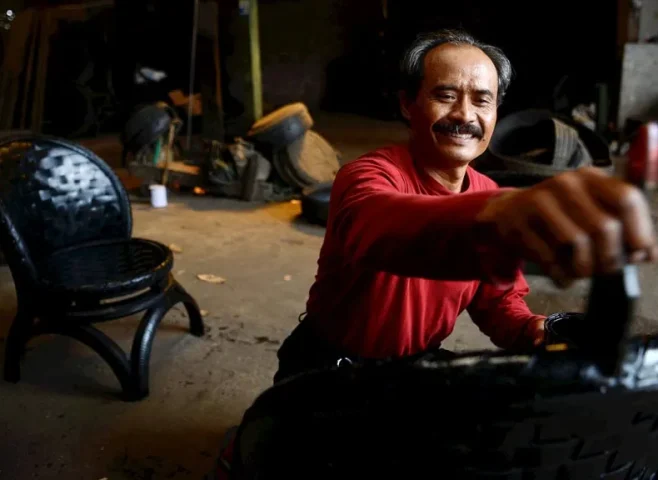
As the world strives to manage tire waste, Freee Recycle in Nigeria is turning used tires into bricks, floor tiles, flip-flops, and other items.
Ifedolapo Runsewe, the organization’s Managing Director, said it’s not difficult to spot the problem on Nigerian roads.
“I think if you walk for five minutes or ten minutes, I guarantee you’ll see at least ten tires, right? You find them in drains, you find them on street corners where they shouldn’t be,” he said.
“It’s also quite versatile in terms of its base materials, especially rubber, which is mostly used here. And even steel, which is quite valuable, and there are also fibers, which have their own benefits and uses,” he added.
Freee Recycle began operations in 2018 with about four employees. The plant’s workforce has since grown to over 150. The company says it has processed more than 600,000 tires, over 400,000 of which have been recycled into new products.
Tires are processed and ground into small pieces. The waste is then mixed with adhesives, allowing workers to process the waste into a wide variety of products.
The company’s most popular product is rubber paving stones, which cost around $60 for a set of 40.
Freee Recycle products are available in major Nigerian cities, including Lagos, Abuja, and Port Harcourt.
Some recycled products are slightly more expensive than their pre-made counterparts, and the manufacturer attributes this to their longer shelf life.
Bolanle Emmanuel, coordinator of the Nigerian Export Promotion Council in Oyo State, said one of the challenges is distributing raw materials to these locations.
“This is the only tire recycling industry I’ve ever seen in Nigeria. Processing scrap like this, and used tires into rubber, that’s it,” he said.
“I think to overcome this challenge, they could replicate this processing center in different communities, where they can cut the tires into sacks. Once the tires are cut into different sizes, they can be easily transported to their desired location for use in the final product,” Emmanuel added.
Freee Recycle believes it has prevented more than 8,100 tons of CO2 emissions since it began operations.
“Environmentally, they are making good use of materials that would normally be thrown away or burned, causing significant air pollution,” said Eid Zouki, a construction engineer who recently commissioned Freee Recycle to supply floor tiles for a school.
“Perhaps on a larger scale, we now have a more environmentally conscious society worldwide. Using environmentally friendly materials, reusing, recycling, and utilizing materials that would normally be thrown away will become a trend, and will eventually be implemented across Africa,” he added.


admin
March 11, 2018The recording starts with the patter of a summer squall. Later, a drifting tone like that of a not-quite-tuned-in radio station rises and for a while drowns out the patter.
admin
October 24, 2018Some need to protect very valuable information. All these factors should be taken into account.
admin
October 24, 2018All these factors should be taken into account. A risk-aware Windows user can probably survive without any anti-virus software at all.
admin
October 23, 2018The Rangers needed a jolt for their first home game of their second-round series against the Ottawa Senators. Turning to Tanner Glass and his physical style.